
Beginner Guides
How Long Does Paint by Numbers Take?
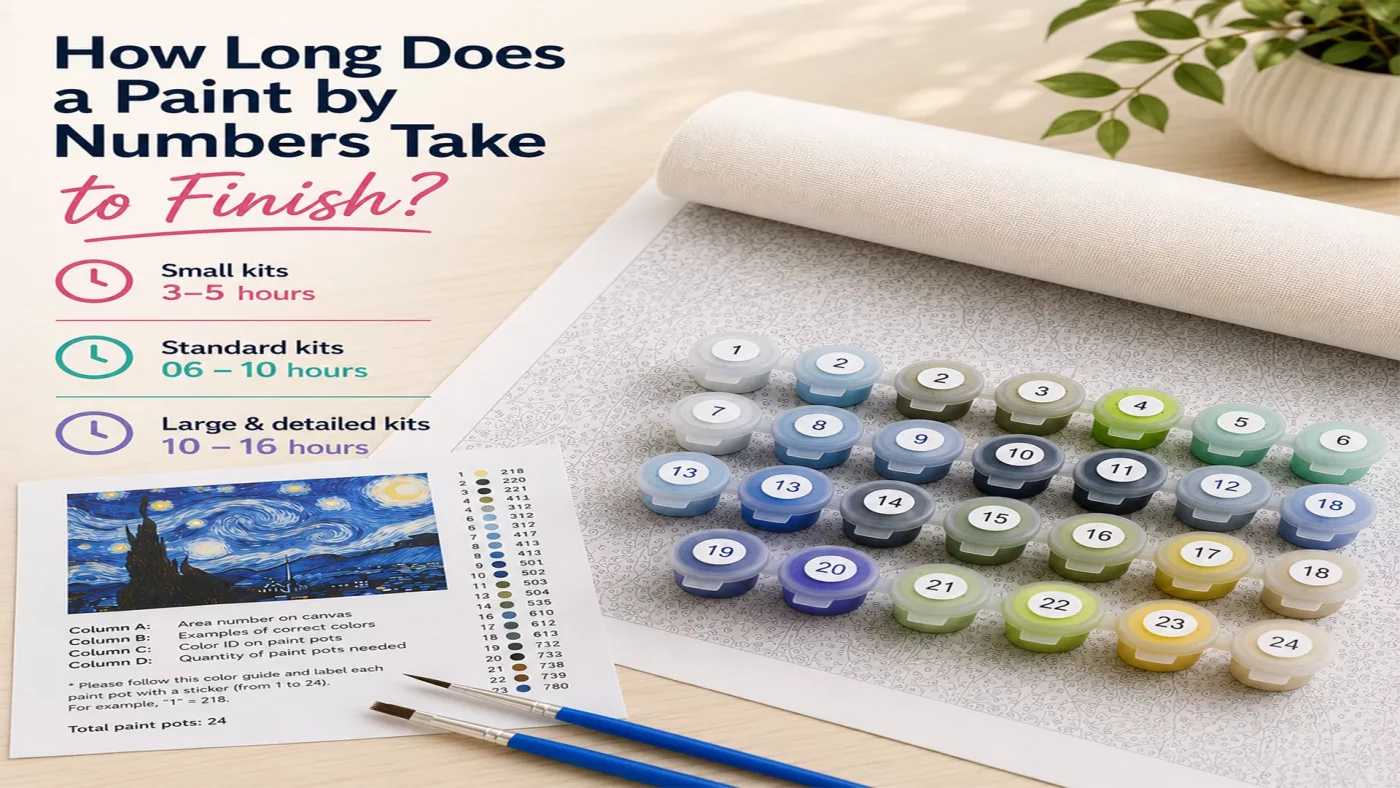
The honest answer is: it depends. A small, simple canvas can be a single cosy evening, while a large, detailed one might be a project you happily return to over a few weeks. But that vagueness isn’t very helpful when you’re trying to plan, so below we’ve put real time ranges to it — by size and by colour count — plus what actually speeds you up or slows you down along the way.
Why there’s no single answer
Three things decide how long a paint by numbers canvas takes, and they pull in different directions. The first is size — more canvas means more surface to cover, plainly. The second is detail, which usually shows up as the colour count: a 24-colour design has larger, simpler regions than a 48-colour one packed with tiny gradients. The third is you — your pace, your experience, and honestly your mood on the night. Someone who paints most evenings will move faster than someone opening their very first kit, and neither is doing it wrong.
So when a friend says “that took me twelve hours,” treat it as a loose guide, not a promise. What follows are realistic ranges for an unhurried adult painting at a comfortable, steady pace — not racing, not dawdling.
Rough timings by size & colour count
These are total active painting hours, not calendar time. Most people split them across several sittings. Larger canvases in our range naturally carry higher colour counts, which is why the detailed end of the table climbs quickly.
| Canvas size | 24 colours | 36 colours | 48 colours |
|---|---|---|---|
| Small (approx. 8×10–11×14 in) | 3–5 hrs | 5–8 hrs | 7–11 hrs |
| Medium (approx. 12×16–16×20 in) | 6–10 hrs | 9–15 hrs | 13–20 hrs |
| Large (approx. 20×24 in and up) | 10–16 hrs | 15–24 hrs | 22–35+ hrs |
Not sure which size you’re looking at? Our size guide shows each canvas against a wall and a sofa, so you can picture the real dimensions before you choose — and estimate your hours from the table above.
What speeds you up
A few habits genuinely shave hours off a canvas, and none of them mean rushing:
- Fewer, larger colour regions. A lower colour count means bigger areas and fewer brush changes. Our easy paint by numbers designs are built exactly this way.
- Painting one number at a time. Finish every region of colour 1 before moving on. You rinse less, and you find your rhythm.
- Good light and a flat table. You spend less time squinting for the next tiny number, and your edges come out cleaner the first time.
- Experience. Your second canvas is almost always quicker than your first. Your hand learns how much paint to load and how to cut a clean edge.
What slows you down
And a few things that add time — some worth it, some avoidable:
- High detail. Faces, fur, water and skies with lots of blended tones mean many small regions. Beautiful, but slow. If you’re weighing this up, our honest take on whether paint by numbers is hard is worth a read.
- Second coats. Light colours over dark printing often need a second pass. That’s the paint doing its job, not a mistake — just budget for it.
- Drying pauses. Acrylics dry fast, but if you like to layer or touch up, you’ll wait a little between passes.
- Stopping to fuss. Perfecting every edge under a magnifier is lovely and slow. Totally allowed — just know it’s a choice.
Why taking your time is the point
It’s easy to treat a paint by numbers kit like a task to be cleared. But the whole appeal is the opposite of that. The slow, repetitive filling-in is the reward — a quiet, screen-free hour where your mind settles into one small, satisfying job. Plenty of people tell us the painting is the bit they look forward to all week, and they’re almost sorry when the canvas is done.
So if the table above says “twenty hours” and that sounds like a lot, reframe it: that’s twenty calm evenings-in you get to keep, ending in something real on your wall. There’s no deadline. A canvas left half-finished on the shelf for a fortnight is waiting patiently, not judging you.
Finishing faster (without rushing)
If you do have a date in mind — a birthday, a house move, a gift — here’s how to keep momentum without turning a relaxing hobby into a chore:
- Block out short, regular sittings. Three focused thirty-minute sessions beat one exhausted marathon, and the work looks tidier for it.
- Do all of one colour, top to bottom. Batching a single number across the whole canvas is the single biggest time-saver.
- Start with the big regions. Clearing the large areas first makes the canvas feel “nearly there,” which keeps you going.
- Leave the fiddly detail for a fresh, well-lit sitting — when your hand is steady, not at the tired end of a long session.
- Don’t chase perfection on hidden areas. A tiny region in a dark corner doesn’t need three coats. Save that care for the focal point.
A word on custom photo canvases
If you’re painting a custom canvas from a photo — a face, a pet, a family shot — expect it to sit at the higher end of the table. Portraits and pets need 36 to 48 colours to capture skin tones and fur, so there are more, smaller regions to work through. That extra time is exactly why the result feels so special: you’re not filling in a stock scene, you’re slowly bringing back a real memory. It’s worth the care, and we build in a proof you approve before we print so the picture you paint is right from the start. If you’d like a steady evening or two of gentle painting, browse our paint by numbers for adults range, or read the complete beginner’s guide before you start.
Find a canvas worth your evenings
Whether you want a relaxed small design or a memory turned into a keepsake, there’s a kit sized for the time you’ve got. We show you a proof before we print, with free revisions until it’s right.
Start My Custom Canvas